For many homeowners in Pennsylvania—from the historic neighborhoods of Philadelphia to the suburban stretches of Hermitage—the crawl space is often a “out of sight, out of mind” area. However, this dark, narrow void beneath your feet plays a maassive role in the health, comfort, and efficiency of your entire house. In the Mid-Atlantic climate, characterized by humid summers and bone-chilling winters, an open or vented crawl space acts as an open door for moisture and fluctuating temperatures.
At Guardian Basement Waterproofing, we have spent decades helping homeowners understand that your house is a system. When the bottom of that system is compromised, the effects rise through the floors and into your living space. If you have noticed rising energy bills or a lingering scent you can’t quite scrub away, your crawl space might be the culprit. Here are the five definitive signs that it’s time to consider crawl space encapsulation.
The “Stack Effect”: How Your Crawl Space Controls the Air You Breathe
To understand why a crawl space matters, you must understand the “Stack Effect.” In simple physics, warm air rises. As the warm air in your home escapes through the attic and upper levels, it creates a vacuum that pulls air from the lowest point of the house upward. In most PA homes, that air is pulled directly from the crawl space.
If your crawl space is filled with damp soil, mold spores, or pest waste, that is exactly what you are breathing in your living room and bedrooms. In fact, studies show that up to 50% of the air on the first floor of a home originated in the crawl space. Encapsulation breaks this cycle by creating a physical barrier between the earth and your home.
5 Warning Signs Your Crawl Space Needs Professional Attention
1. Persistent Musty Odors on the First Floor

Do you notice an earthy, damp smell when you walk into your home after it’s been closed up for a few hours? This isn’t just “old house smell.” It is usually the scent of microbial volatile organic compounds (mVOCs) produced by mold and fungus growing in the dark, damp environment under your floor joists. Because of the stack effect, these odors are pushed upward, signaling that moisture levels are high enough to support fungal growth.
2. Cupping Hardwood Floors or Warping Woodwork
Wood is a hygroscopic material, meaning it absorbs moisture from the air. When the humidity in your crawl space is high, the underside of your hardwood flooring absorbs that moisture and expands. This causes the edges of the planks to rise higher than the center, a phenomenon known as “cupping.” If you notice your beautiful hardwoods starting to feel uneven, the problem is likely coming from the humidity below.
3. Unexplained Increases in Monthly Utility Bills
If you feel like your HVAC system is working overtime but your home never feels quite comfortable, check your crawl space. Damp air is much harder to heat and cool than dry air. Furthermore, open vents allow cold winter air or humid summer air to sit directly against your HVAC ducts and the underside of your floor. Encapsulation acts as an extra layer of insulation, stabilizing the temperature and reducing the load on your furnace and air conditioner.
4. High Humidity Levels and Condensation on Pipes
In Pennsylvania’s humid summers, warm air enters crawl space vents and hits the cooler surfaces of water pipes or foundation walls. This results in condensation, often called “sweating.” This standing water drips onto the soil or wood framing, creating a localized swamp that invites rot and structural decay. If you see “sweating” pipes, your humidity levels are dangerously high.
5. Pest Infestations (Rodents and Insects)
Mice, spiders, termites, and wood-boring beetles are all attracted to moisture. A dirt crawl space provides the perfect habitat: it’s dark, damp, and offers easy access to the wooden “bones” of your home. By sealing the floor with a heavy-duty vapor barrier and closing off entry points, encapsulation makes your home significantly less attractive to unwanted guests.
The Benefits of a Full Encapsulation System
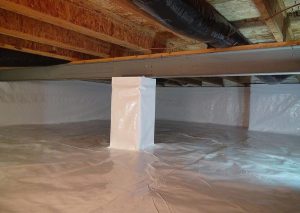
Encapsulation is more than just laying down a piece of plastic. It is a comprehensive engineering solution designed to turn a liability into an asset.
Implementing Heavy-Duty Vapor Barriers
We use high-grade, reinforced polyethylene liners that are much thicker and more durable than standard hardware store plastic. These are tucked and sealed to the walls and piers, creating a seamless “white box” that prevents moisture from evaporating out of the ground.
The Importance of a Dedicated Dehumidification System
Sealing the crawl space is the first half of the battle; the second half is controlling the air. A professional-grade dehumidifier ensures that the humidity stays below 55%, the threshold where mold and wood rot cannot survive. This keeps the environment bone-dry and the air quality pristine.
Frequently Asked Questions (FAQ)
Is a vapor barrier the same as full encapsulation?
No. A standard vapor barrier usually only covers the dirt floor and is often loosely laid. Full encapsulation involves sealing the floor, the foundation walls, and all vents, turning the crawl space into a “conditioned” space similar to the rest of your home.
How long does crawl space encapsulation last?
When installed by professionals like Guardian Dry, our high-grade liners and sealing components are designed to last for 20 years or more. It is a long-term investment in the structural health of your Pennsylvania home.
Can encapsulation really lower my heating and cooling costs?
Absolutely. By stopping the infiltration of outdoor air and the stack effect, homeowners typically see a 15% to 20% reduction in their energy bills, allowing the system to eventually pay for itself over time.
Take control of your home’s air quality and energy efficiency. Schedule your crawl space evaluation with Guardian Dry’s Pennsylvania experts today and breathe easier tomorrow.

With more than 40 years of experience in the industry in both residential and commercial waterproofing; serving the Maryland Metropolitan area and Pennsylvania. Guardian has a proven record of expertise and excellent customer service. Our staff are trained and skilled technicians that work to permanently stop foundation water leaks. Guardian installs state of the art systems and specializes in basement waterproofing, basement finishing, crawl space waterproofing, repair and foundation repair.