Many homeowners in York, PA, spend a significant amount of time and money improving their indoor air quality. They buy high-end air purifiers, change HVAC filters monthly, and vacuum with HEPA-certified machines. Yet, despite these efforts, a persistent musty odor remains, and allergy symptoms seem to flare up the moment they step through the front door. The culprit isn’t in the living room or the bedroom—it is right beneath your feet.
At Guardian Basement Waterproofing, we often see how the “out of sight, out of mind” nature of crawl spaces leads to significant health and structural issues. To understand why a damp crawl space is a problem for your entire home, you first have to understand a physical phenomenon known as the Stack Effect.
Understanding the “Stack Effect” in Your Home
The Stack Effect, also known as chimney effect, is the movement of air into and out of buildings. In the simplest terms, your home acts like a giant vacuum. Warm air is lighter than cold air; as the warm air in your living spaces rises and eventually escapes through the attic and roof vents, it creates a pressure vacuum in the lower levels of the house.
Why Warm Air Rises and Pulls Moisture Upward
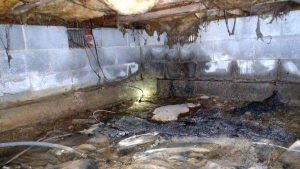
As that warm air exits the top of your home, it must be replaced. The “makeup air” is pulled upward from the basement or crawl space through floorboards, electrical wire penetrations, and plumbing stacks. In a typical home, as much as 50% of the air you breathe on the first floor originated in the crawl space. If that space is damp, dark, and filled with mold spores, that is exactly what you are breathing in upstairs.
The Physics of “Bad Air” Migration
This migration isn’t just a theory; it is a measurable physical process. In York, PA, where humidity levels can spike during the summer, a vented crawl space acts as a portal for moisture. The heavy, humid air enters the vents, cools down, and condenses on your wooden floor joists and insulation. The Stack Effect then takes that humidity and distributes it throughout your living environment.
The Hidden Dangers of an Untreated Crawl Space
A damp crawl space is more than just a nuisance; it is a breeding ground for biological contaminants that can impact the structural integrity of your home and the health of your family.
Mold Spores and Mycotoxins in Your Living Room
Mold thrives in environments with more than 60% relative humidity. In an unsealed crawl space, humidity often exceeds 80%. As mold grows on organic material like wooden joists or paper-backed insulation, it releases microscopic spores and mycotoxins. Thanks to the Stack Effect, these allergens are delivered directly into your bedrooms and kitchen.
Dust Mites and Humidity-Driven Allergies
Dust mites do not drink water; they absorb moisture from the air. High humidity levels in the crawl space lead to a population explosion of dust mites. For residents in Southern PA dealing with asthma or respiratory sensitivities, a damp crawl space can be the primary trigger for year-round symptoms.
Signs Your York, PA Home Has a Moisture Problem
How do you know if your crawl space is compromising your air quality? Look for these localized warning signs:
- Cupping Hardwood Floors: If your floorboards are beginning to warp or “cup” (the edges are higher than the center), moisture is likely attacking the underside of the wood from the crawl space.
- Musty Odors: That “old house” smell is actually the off-gassing of mold and bacteria (known as MVOCs). If the smell is stronger near the floor, the crawl space is the source.
- High Indoor Humidity: If your air conditioner struggles to keep the house feeling “crisp” in the summer, it may be fighting a constant influx of moisture from below.
The Guardian Approach to Crawl Space Health
The solution isn’t just to “air it out.” In fact, York’s humid climate means opening vents only makes the problem worse. The answer is Crawl Space Encapsulation.
Vapor Barriers: Why 6-mil Poly Isn’t Enough
Many builders use a thin, clear plastic sheet on the crawl space floor. These are easily torn and do not stop water vapor effectively. Guardian Dry utilizes heavy-duty, nylon-reinforced vapor barriers that are permanently sealed to the walls and pillars, creating a total moisture block.
The Role of the Sentinel HDi90 Dehumidifier
Once the space is sealed, we install a high-performance Sentinel HDi90 Dehumidifier. Unlike a standard basement dehumidifier, this unit is designed for the harsh conditions of a crawl space. it maintains a consistent 45-50% humidity level, effectively “killing” the conditions mold needs to grow and stopping the Stack Effect from pulling “bad air” into your home.
Frequently Asked Questions (FAQ)
Q: Why does my crawl space smell worse in the summer?
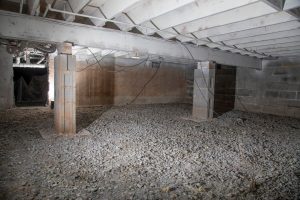
A: High humidity in Southern PA causes “condensation cycles” in vented crawl spaces. When warm, humid outdoor air hits the cooler air under your house, it turns into liquid water, feeding mold and bacteria which release musty-smelling gases.
Q: Will encapsulating my crawl space lower my energy bills?
A: Yes. By sealing out humid air, your HVAC system doesn’t have to work as hard to condition the air. This can result in savings of up to 15-20% on your heating and cooling costs.
Q: Is a vapor barrier the same as encapsulation?
A: No. A vapor barrier is just a liner on the floor. Full encapsulation involves sealing the vents, wrapping the walls, and installing a dedicated dehumidifier to create a completely dry, controlled environment.
Breathe easier starting today. If you suspect your crawl space is affecting your home’s air quality, don’t wait for mold to take hold. Contact Guardian Basement Waterproofing for a comprehensive crawl space audit in York, PA, and the surrounding areas. We provide the permanent, lifetime-guaranteed solutions your family deserves.

With more than 40 years of experience in the industry in both residential and commercial waterproofing; serving the Maryland Metropolitan area and Pennsylvania. Guardian has a proven record of expertise and excellent customer service. Our staff are trained and skilled technicians that work to permanently stop foundation water leaks. Guardian installs state of the art systems and specializes in basement waterproofing, basement finishing, crawl space waterproofing, repair and foundation repair.